Article
June 25, 2026
Urgent steps to meet AASB S2 reporting requirements
A focused briefing for large Australian entities with mandatory climate reporting obligations for the 2025/26 financial year. If you work in compliance, legal, finance, or environment for a large business in Australia, read this article, get prepared, and act now.

Contact our expert

Oliver Jakins
Senior Climate and Environmental Assessor
Whilst comprehensive, the compliance burden of AASB S2 has been slightly reduced in Australian Government’s 2026 Whole-of-Government Regulatory Reform Agenda. It aims to better define ‘undue cost or effort’, to adjust assurance settings so they are proportionate, and to set clear boundaries on supplier information requests.
In 2024, the Australian Sustainability Reporting Standards (ASRS) introduced mandatory climate reporting through AASB S2 Climate-related Disclosures. The standard requires entities to disclose climate-related risks and opportunities and systems to manage them, including governance, strategy, risk management, and relevant metrics and targets, as well as Scope 1 and 2 GHG emissions. AASB S2 is legally enforceable, and directors must declare that the report complies with the standard.
Who needs to disclose by October?
The first mandatory AASB S2 reports are due this year, with Australia’s largest entities (including overseas subsidiaries) reporting first. For Group 1 entities with a 30 June year-end, the 2025/26 reporting period closes soon, and under Section 319 of the Corporations Act 2001, the climate disclosure report must be lodged with ASIC alongside the annual financial report. For most, that means a lodgement window of September to October 2026.
Are you in scope?
AASB S2 is mandatory based on financial criteria or NGER obligations. If you have a 30 June year-end and meet Group 1 criteria, your first report is due by October.
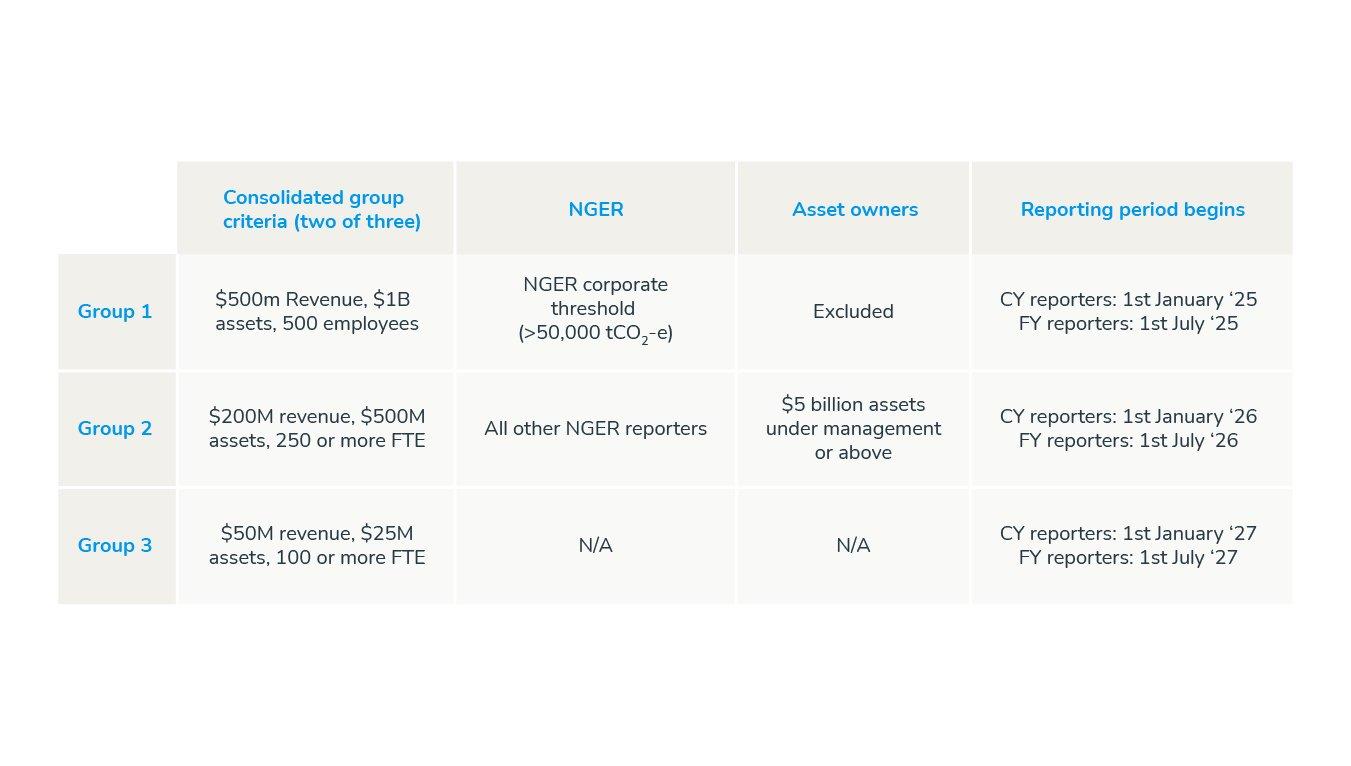
Is your company part of a global group?
Group 1, 2 or 3 status is not limited to Australia. Classification is assessed at the consolidated group level, not by the size of the Australian reporting entity alone. As a result, overseas subsidiaries could reframe an otherwise mid-sized Australian entity into Group 1 status, requiring immediate preparation for the first wave of mandatory climate reporting.
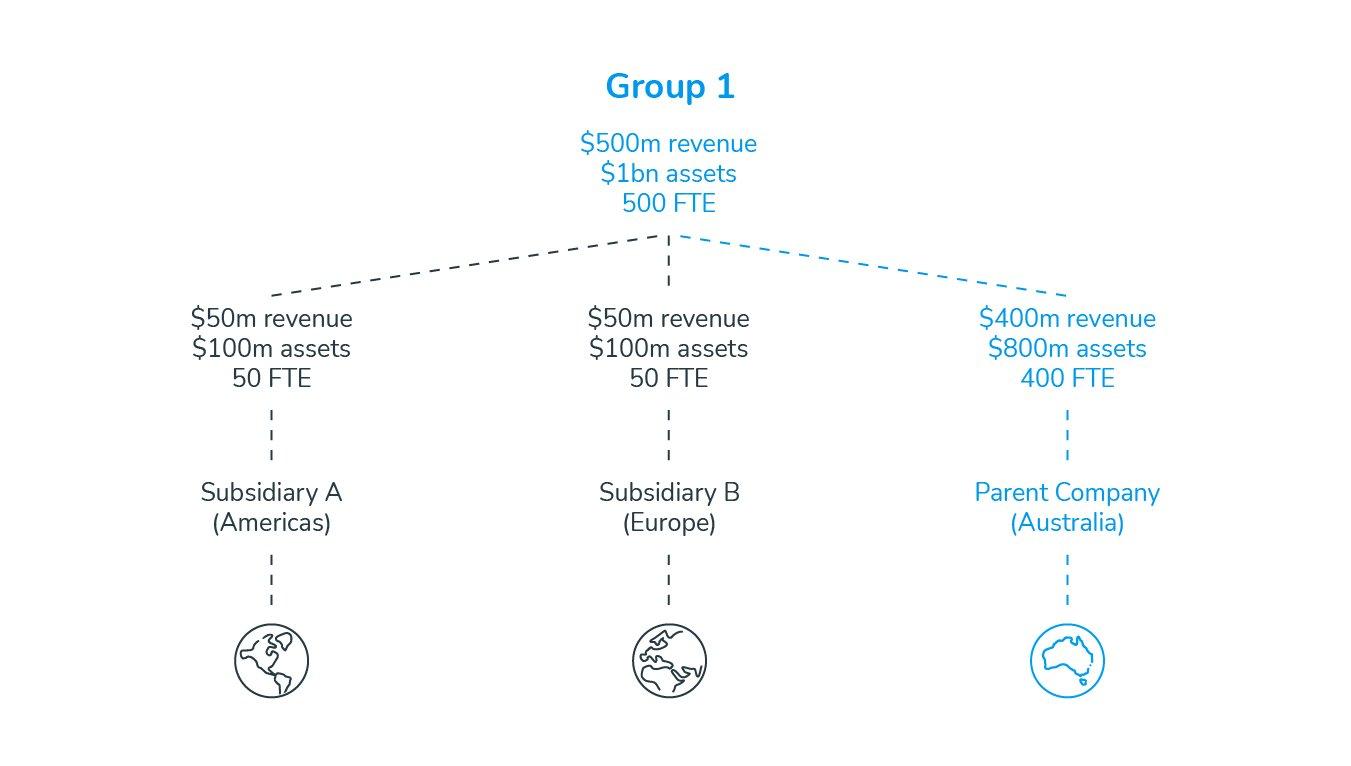
Foreign entities are not directly subject to AASB S2 unless controlled by an Australian reporting entity, in which case their financials are included in the consolidated group thresholds for determining reporting status. Overseas parents of Australian companies are not subject to AASB S2 reporting.
An international footprint also matters for more than just AASB S2. Although AASB S2 is an Australian standard, it is aligned with IFRS S2, the global climate disclosure framework being adopted or considered across jurisdictions, Brazil, California, Japan, Malaysia, New Zealand, Nigeria, Singapore, Türkiye, and the UK. Likewise, AASB S2 can be seen as a similar equivalent to the EU’s Corporate Sustainability Reporting Directive (CSRD). While the financial thresholds differ by jurisdiction, businesses operating across Australia and these markets should be preparing now.
Climate reporting preparation should be treated as an immediate priority and considered through a global, not just an Australian, lens.
Where are you currently?
If you already have an IFRS S2 or TCFD report from previous reporting years, this provides a good foundation for the AASB S2 reporting requirements. The focus is then on adjusting the existing report to ensure it meets the requirements by the deadline. This can be achieved through a review of the requirements and benchmarking against peers to ensure the report is of sufficient quality and assurance-ready.
However, if this report is not currently developed, focus should be on developing an AASB S2 aligned report, ensuring it meets the requirements and deadline.
How to get prepared
With weeks remaining before the deadline, the priorities are:
- Lock down scope 1 and 2 emissions data with a clear audit trail to source records: utility bills, fuel records, emission factors, estimations and gaps.
- Complete climate scenario analysis against different global warming pathways (such as 1.5°C and >2°C), with assumptions, the inclusion of Australian datasets and a link between risks, the entity’s strategy and financial performance.
- Document governance, such as board minutes, terms of reference, management roles, and the relationship between climate risk and enterprise risk.
- Use Australian datasets to translate the existing IFRS S2 or TCFD report (if one exists) into an AASB S2-compliant disclosure by closing Australian-specific gaps, including the use of relevant local climate datasets from the Commonwealth Scientific and Industrial Research Organisation (CSIRO) and GHG emissions factors from Department of Climate Change, Energy, the Environment and Water (DCCEEW).
- Draft the report against AASB S2 requirements and ASIC 280, then engage your assurance provider on a working draft.
How Ramboll can support
Ramboll's Australian and global teams support in-scope entities at every step of an AASB S2 disclosure, and we are working with several Group 1 reporters in the run-up to October. We can help with:
- Climate risk assessment and scenario analysis using HazAtlas, our proprietary physical climate risk modelling platform, calibrated to your asset locations, value chain, and the ASSB S2 hierarchy.
- GHG inventory development and verification for Scope 1, 2 and 3 emissions, including audit-trail documentation that will withstand limited and reasonable assurance.
- Governance and risk integration, embedding climate risk into existing enterprise risk management, board oversight processes, and internal controls.
- Report drafting and assurance readiness review against AASB S2 and RG 280, including support engaging with auditors.
Ramboll has prepared climate-related financial disclosures for some of the world's largest companies under TCFD, ISSB, CSRD and now AASB S2 frameworks. If your first report is due this October and you need rapid, expert support or a second pair of eyes on a draft, please get in touch with our global team.
Future requirements
Irrespective of the entity’s Group, mandatory information is disclosed gradually, with limited topics in year one of reporting, and all topics by year four.
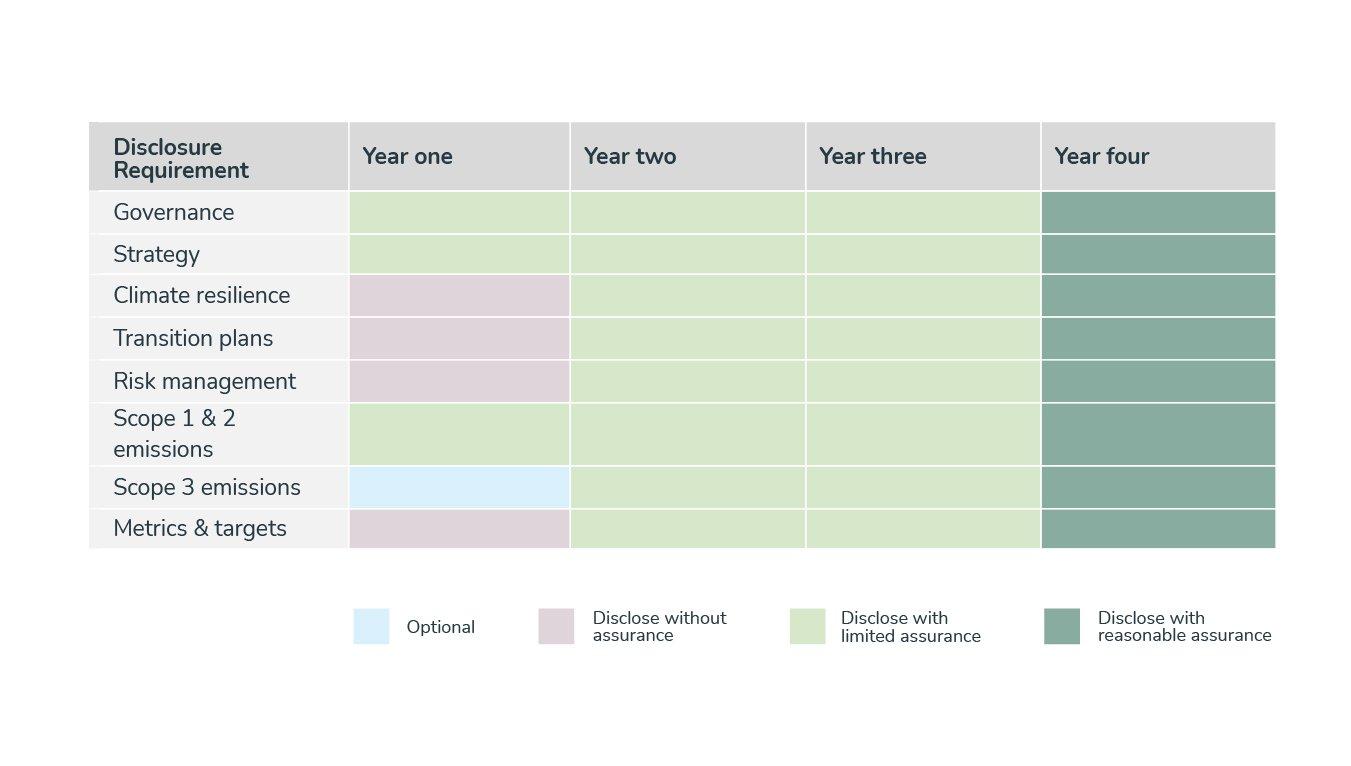
Assurance is phased in. In year one, limited assurance is required over governance, strategy and Scope 1 and 2 emissions, in year two, limited assurance is required for all topics, and by year three, reasonable assurance is required overall.
What must be in the report
AASB S2 disclosures are organised around four pillars: governance, strategy, risk management, and metrics and targets. In detail, they are:
- Governance of climate-related risks and opportunities, including board and management oversight processes.
- Strategy, including material climate-related risks and opportunities, the current and anticipated financial effects, and climate change risk assessment (CCRA) including climate scenario analysis using different scenarios – ideally one consistent with limiting warming to 1.5°C and one exceeding 2.5°C.
- Risk management processes and how they integrate with the entity's overall risk management framework.
- Metrics and targets, including Scope 1 and 2 GHG emissions (location-based, in line with the GHG Protocol or NGER), industry-based metrics where applicable, and any climate-related targets including those required by law such as the Safeguard Mechanism. Scope 3 emissions must be reported from the year two of reporting.
For more information, contact:
Oliver Jakins, Perth, WA (Senior Climate and Environmental Assessor)
Victoria Sedwick, Sydney, NSW (Principal)
James Walker, Sydney, NSW (Senior Managing Consultant)
Lara Alvarez, London, UK (Lead Consultant)
Dr. Dale Tromans, Chester, UK (Principal Consultant)
Dr. Ross Beardsley, Novato, CA, USA (Senior Managing Consultant)
Grace Cook, Charlotte, NC, USA (Senior Managing Consultant)
Contact our expert
Senior Climate and Environmental Assessor